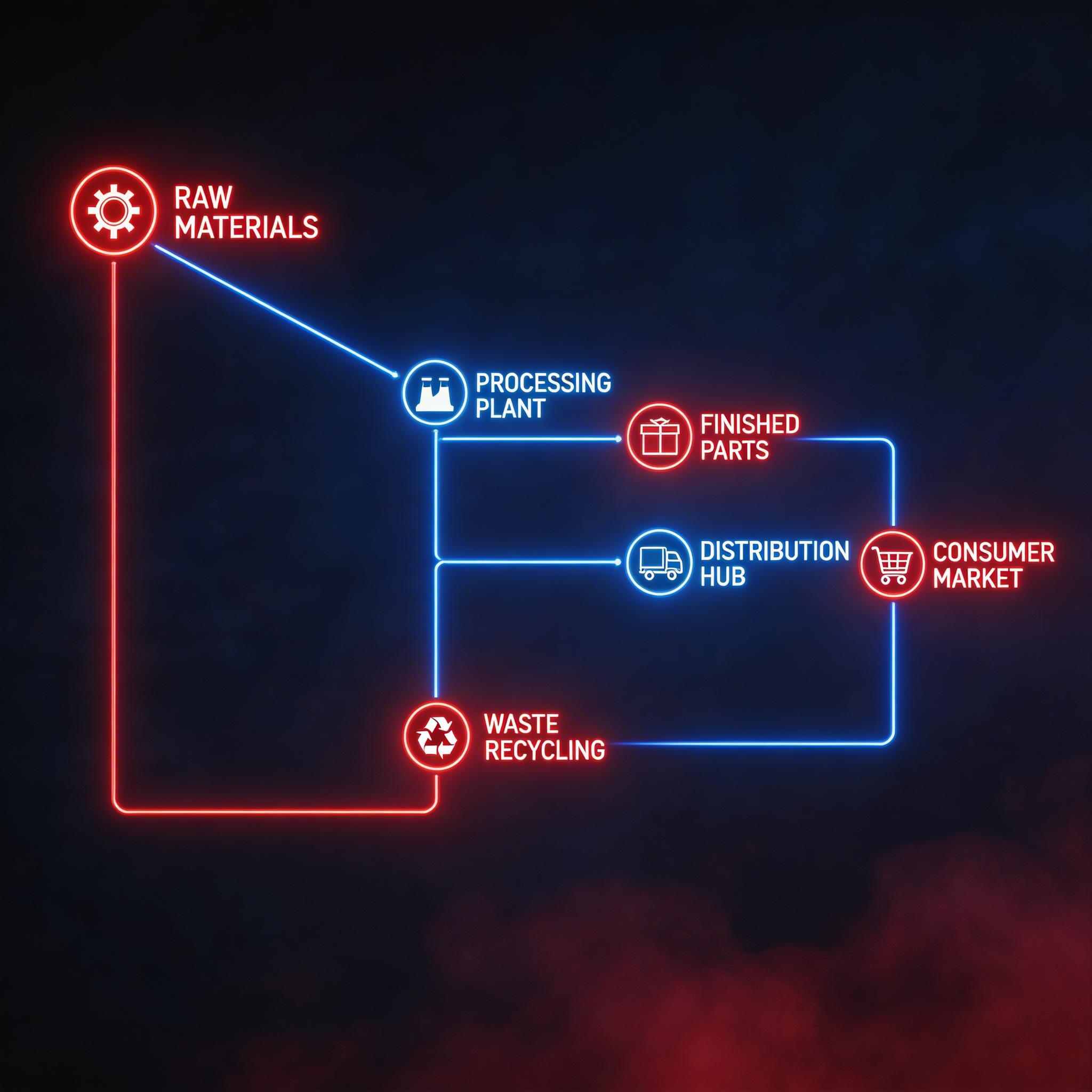
While basic merge games are about matching pairs, the "Complex Merge Simulators" of 2026 are about managing intricate industrial ecosystems. In games like Industrial Echo, you're not just merging items; you're designing a logistics network where the output of one chain is the critical resource for another. This guide will provide you with the "Logistical Framework" to optimize your production and dominate the industrial hierarchy.
1. The Concept of "Throughput Optimization"
The core of advanced merge strategy is "Throughput"—the rate at which you can produce high-tier items. In a complex simulator, every merge is a transformation of time and space into value. Expert players use "Linear Programming" (even if done intuitively) to identify the "Bottleneck Chain"—the part of their factory that is limiting overall growth. By focusing their resources on upgrading this specific chain, they achieve the highest possible ROI.
To master this, you must understand "Input-Output Ratios." Every merge tier has a specific cost in terms of lower-tier items. Pro players use "Tier Buffering" to ensure that their high-speed merge chains never run out of materials. They build "Reservoirs" of mid-tier items that can be quickly funneled into a high-tier merge when an objective appears. This "Strategic Stockpiling" is what allows them to complete complex quests in seconds that would take a casual player hours. In 2026, many simulators feature "Dynamic Markets" where item values fluctuate; mastering these "Price Signals" is the key to industrial dominance.
2. Spatial Logistics and Adjacency Effects
In an advanced merge simulator, the grid is your factory floor. "Spatial Logistics" is the art of arranging your merge chains to minimize "Interference" and maximize "Synergy." Expert players use "Modular Layouts," where each section of the grid is dedicated to a specific resource type. This organization prevents "Resource Contamination," where items from different chains get mixed up and slow down production.
Furthermore, many 2026 titles include "Adjacency Effects"—bonuses that are applied when certain items are placed next to each other. "Synergy Mapping" involves identifying these hidden bonuses and designing your layout around them. A well-placed "Efficiency Core" can boost the production rate of all adjacent merge chains by 20%. Pro players use "Geometric Packing" to fit the maximum number of high-synergy items into the smallest possible space. For the pro, the grid is a "Circuit Board" where every item is a component that must be perfectly placed for optimal performance.
3. Managing the "Energy Economy"
Most complex simulators use some form of "Energy" or "Stamina" to limit the rate of production. The "Energy Economy" is the most critical constraint in high-level play. Expert players use "Energy ROI Analysis" to determine which merges provide the most value for their limited energy. They don't waste energy on low-value merges; they save it for "Power Sprints" where they can trigger a massive cascade of high-tier production.
Mastering this requires "Temporal Efficiency." You have to align your high-energy activities with the game's "Natural Regen" cycles. Pro players use "Overnight Buffering," setting up their chains so that they can be completed the moment they log in with a full energy bar. They also use "Multi-Chain Juggling," switching between different resource types to take advantage of different regen rates. In 2026, many titles feature "Energy Trading," where you can sell excess energy to other players; mastering this "Arbitrage" is the mark of a true industrial tycoon.
4. The Meta-Logistics of Community Trade
Finally, modern merge simulators are "Social Economies." The "Meta-Logistics" involves trading resources and intel with other players to accelerate your growth. Expert players participate in "Trade Guilds," where members specialize in different resource types and trade their surplus to help the collective advance. This "Collaborative Production" is far more efficient than trying to master every chain alone.
In 2026, the mmm community uses "Global Supply Chain Analytics" to track the value of items across different sectors. This data allows players to identify "Export Opportunities"—items that are cheap to produce in their sector but valuable in another. By becoming a "Specialized Exporter," you can generate the wealth necessary to buy high-tier items that would be impossible to produce yourself. For the pro, the game is not just on their grid; it's in the "Global Marketplace." Visit our Sector Analysis to find your industrial niche and start building your empire today.
Logistics is the science of winning before the battle even begins. Master your chains, and you master the game.