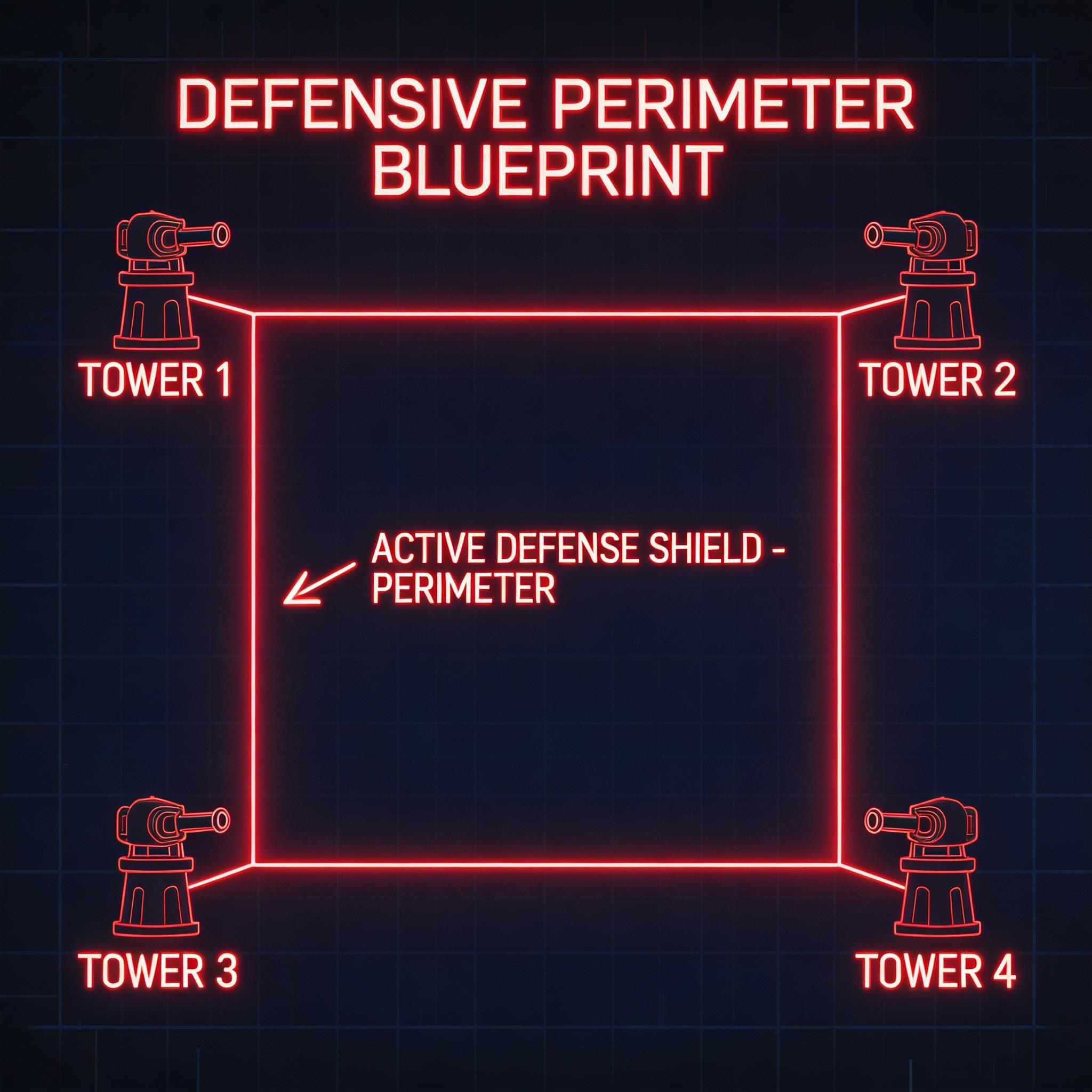
Tower Defense (TD) is often called the "Gentleman's Strategy." It's a game of patient preparation and geometric optimization. While other genres reward fast reflexes, TD rewards the "Architectural Mind"—the ability to see a path and design its absolute destruction. In the 2026 gaming era, where "Active Terrain Modification" has become the standard, understanding these core principles is the only way to hold the line against increasingly intelligent enemy waves. This guide will deconstruct the architecture of the kill zone and provide you with the tactical intel to become a master architect.
1. The Geometry of the Kill Zone: Radial Maximization
The most fundamental concept in TD is the "Kill Zone"—a specific area on the map where multiple towers can focus their fire on a single target. Expert players don't just scatter towers along the path; they identify "High-Value Intersections" where the path curves or overlaps. By placing high-damage, short-range towers at the center of these curves, you maximize their "Uptime" (the percentage of time they are actively firing at an enemy). This is "Radial Maximization," where every degree of a tower's rotation is used for maximum lethality.
A crucial advanced tactic is "Maze Engineering." In games like Nexus Defense: 2026, you aren't just building on a fixed path; you're creating the path itself. The goal is to maximize the "Path Length" while keeping the "Exit Perimeter" defensible. Pro players use "S-Curve Routing" to force enemies to travel the maximum distance through their most concentrated kill zones. In 2026, many TD titles include "Dynamic Pathfinding," where enemies will try to find the shortest route through your defenses. Mastering "Blocking and Channelling"—the art of closing one path to force enemies into another—is the only way to survive these intelligent onslaughts. It's a game of "Spatial Denying" where you control the enemy's every step.
Furthermore, consider "Splash Overlap." In advanced simulations, area-of-effect (AoE) towers have a specific "Blast Radius." Expert architects design their kill zones so that the blast radii of multiple towers overlap at "Bottleneck Points." This creates a "Lethal Density" that can wipe out entire clusters of weak units in a single frame. This "Geometric Stacking" is what allows a well-designed defense to hold against overwhelming numbers.
2. Tower Synergy and Elemental Stacking: The Chemical Reaction
In modern TD, a single tower type is never enough. You must build a "Synergistic Battery"—a combination of towers that complement each other's strengths. The most common synergy is "Slow-and-Burn." You use "Stasis Towers" to reduce enemy speed, increasing the amount of time they spend within the range of your high-damage AoE towers. This "Force Multiplication" is far more efficient than simply building more damage towers. It is the "Tactical Multiplier" that defines elite play.
Furthermore, you must manage "Elemental Stacking." Many 2026 titles feature complex elemental interactions: fire deals more damage to enemies that have been "Oil-Slicked," and lightning arcs between enemies that are "Frozen." Expert players use "Elemental Mapping" to design their kill zones around these interactions. They place "Primer Towers" at the start of a kill zone and "Trigger Towers" at the end to maximize the damage output. For the pro, a TD defense is a "Chemical Reaction" that must be perfectly timed and positioned for maximum effect. Mastering these "Reaction Chains" is key to defeating late-game boss units with massive health pools.
We also see the rise of "Support Cores"—non-attacking units that provide buffs to nearby towers. These include "Range Extenders," "Damage Amplifiers," and "Reload Accelerators." A truly optimized defense is built around these cores, creating "Fortified Nodes" where the effectiveness of every tower is doubled or tripled. This "Node-Based Architecture" is the hallmark of the 2026 tactical elite.
3. Resource ROI and Upgrade Pathing: The Economic Antagonist
Resource management is the "Quiet Antagonist" of TD. You always have more enemies than gold. Expert players use "ROI Analysis" to determine whether it's better to build a new tower or upgrade an existing one. In general, "Upgrade Pathing" favors quality over quantity. A single high-tier tower is often more effective than three low-tier ones because it occupies less space and has a higher "DPS per Pixel" (Damage Per Second). This "Spatial Efficiency" is critical in sectors where building space is limited.
Mastering this requires "Economic Foresight." You have to be able to predict the "Enemy Wave Curve"—the rate at which enemy health and numbers increase. Pro players use "Interest Banking" (in games that feature it) to accumulate wealth during early, easy waves, allowing them to afford massive upgrades just as the difficulty spikes. They also use "Sell-and-Rebuild" tactics to pivot their defense to counter new enemy types. For the pro, the "Upgrade Button" is a tactical weapon that must be used with precision. In 2026, the mmm community uses "Wave Simulators" to test their upgrade paths before committing resources in high-stakes matches. Every credit spent must be a credit toward a definitive kill.
The concept of "Kill-Zone Recycling" is also vital. This involves designing your maze so that enemies pass through the same kill zone multiple times. This effectively doubles the ROI of every tower in that zone. By using "Teleportation Pads" or "Knockback Mechanics," you can keep enemies trapped in a "Lethal Loop" until they are neutralized. This "Temporal Efficiency" is the ultimate expression of architectural strategy.
4. Managing the "Intelligence Gap": The Scouting Advantage
Finally, modern TD is a game of information. The "Intelligence Gap" is the difference between what you know about the upcoming wave and what the game is actually going to throw at you. Expert players use "Scouting Intel"—identifying enemy resistances and special abilities before they reach the kill zone. This allows them to "Pre-Configure" their defense, swapping out useless towers for more effective ones. In 2026, many simulations feature "Fog of War" on the enemy spawn points, requiring active scouting drones to reveal the upcoming threat.
In 2026, the best TD players are "Data-Driven Architects." They analyze the "Kill Efficiency" of every tower and use that data to refine their layouts. They participate in "Tactical Exchanges" with other players to share the most effective mazes and synergy batteries. For the pro, a TD match is not just a game; it's a "Stress Test" for their architectural theories. They build "Redundant Systems" to ensure that if one part of the defense fails, there is a secondary kill zone ready to catch the leak. This "Defense in Depth" is the mark of a true master architect.
The mmm community fosters this collaborative design through our "Blueprint Shares," where players upload their most successful layouts for analysis and critique. By working together, we build the most impenetrable defenses in the browser world. Visit our Sector Analysis to find the perfect terrain for your next defensive masterpiece and join the network of elite architects. The line must hold, and the math says it will.
The best defense is not just a wall; it's a perfectly designed trap that the enemy never sees coming. Master the geometry, and the line will never break.